
Neoclouds and Sovereign Clouds
Stained Glass Transform (SGT): the inference privacy layer for Sovereign Token Factories.
Annual revenue on the same 128 GPUs
$5.6M
$10.1M
+$4.5M
Without SGT
Dedicated nodes, rented
With SGT
Serverless, pay-per-token
Illustrative: 128 NVIDIA B200 GPUs, gross revenue a year.
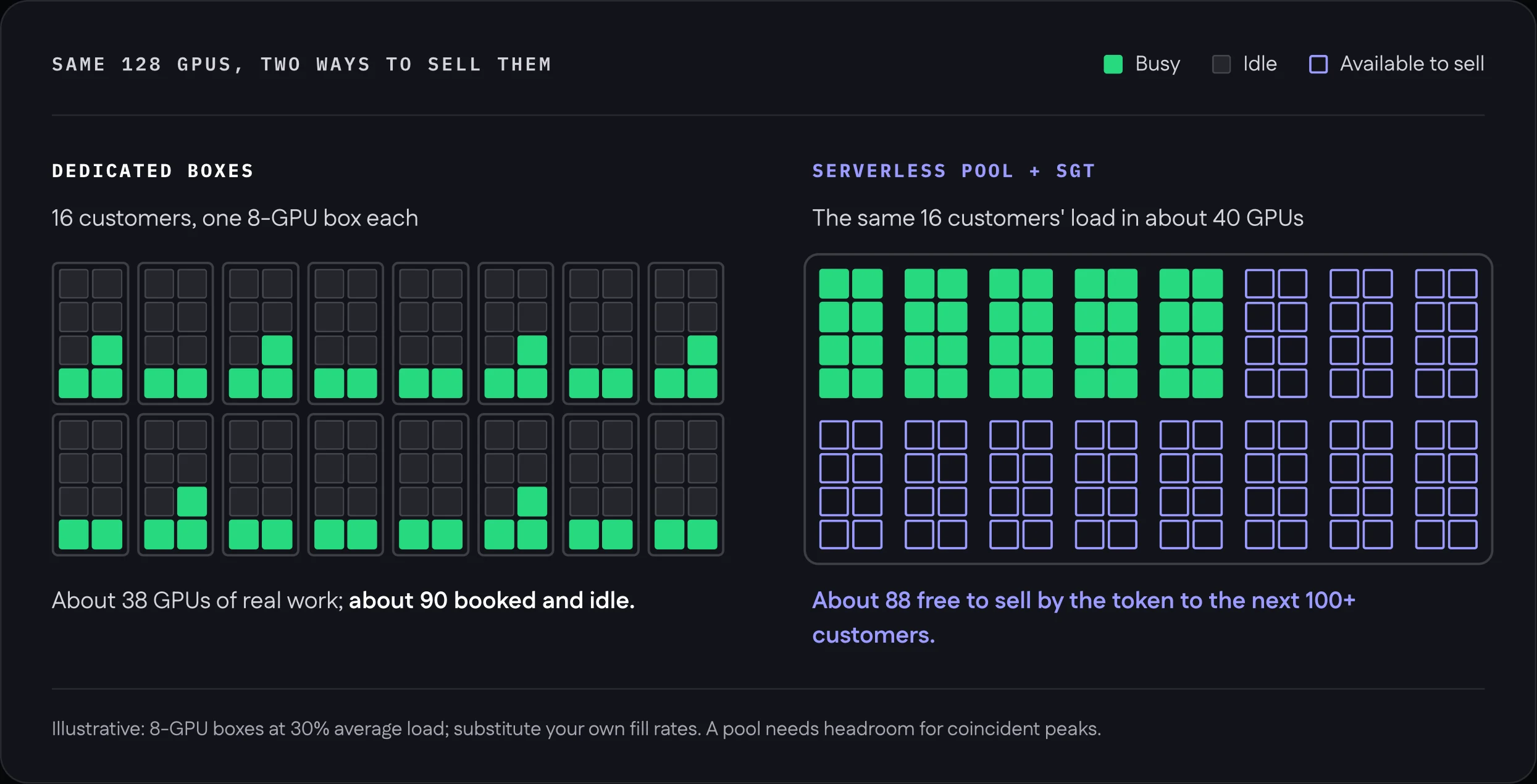
Unused GPU Capacity
Stained Glass Transform converts prompts and context into protected representations, meaning no plaintext lands on your system. Customers get full data sovereignty, and operators can monetize excess capacity as pay-per-token serverless inference.
Dedicated Capacity
Supply
Every customer on dedicated capacity takes at least a whole node. The nodes run out quickly while the GPUs sit idle, and the next customer hears "no capacity."
Revenue
Idle GPUs leave money on the table. Dedicated endpoints bill by the hour whether requests arrive or not. Every idle cycle on a dedicated GPU is a token you could have sold and never will.
Trust
Dedicated does not mean protected. Your stack still handles plaintext in transit, at rest and in compute: logs, traces, metadata, host and GPU memory. That’s why customers keep their most sensitive work off your platform.
For Neoclouds
On dedicated and serverless endpoints alike, your stack receives protected representations, not plaintext, which customers can inspect.
Any request can land on any GPU, so idle time becomes sellable time. Bill the SGT-enabled endpoint by the token like any catalog item and monetize every cycle.
Customers who still want dedicated endpoints bring the workflows they kept at home onto them, because their plaintext is never on your stack.
How It Works
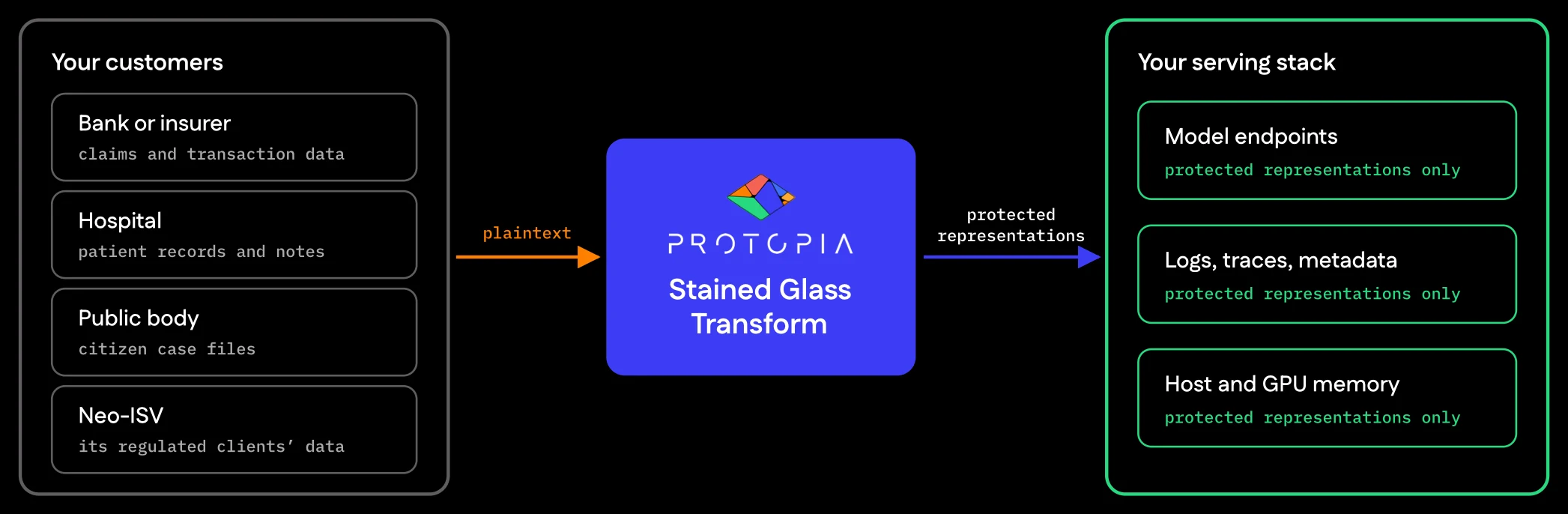
Plaintext, video, and images are transformed by SGT. Your serving stack receives protected representations, on dedicated and serverless endpoints alike.
The model is not retrained or modified; the transform is what is trained. The unchanged model reads its output directly on vLLM or NIM. Transforms exist today for NVIDIA Nemotron 3 and Llama 3.3 70B among others.
As a container in the customer's environment, or as the entry point of your token factory with an API the customer can call to see the transform's output; the client still talks to an OpenAI-compatible endpoint.
The transform runs once per generation call. Output quality lands within a few points of the raw model, some benchmarks at parity.
Mask or redact what policy requires; the model still has to reason over what remains, and encryption ends where the AI factory begins. SGT protects that context in transit, at rest and in compute, with no key and no inversion step. Compatible with, but not dependent on, Confidential Computing.
Partners
Read more
Rafay blog · July 2026
Private Token Factories: How Rafay and Protopia AI Let Sensitive Workloads Run on Shared GPU Capacity
Protopia blog · Sept 2026
Rafay Token Factory publishes and meters your SGT-enabled endpoints, and Protopia AI Stained Glass Transform keeps customer plaintext off your stack.

Protopia blog · May 2026
Zero-Trust AI Factories Unlock Sensitive AI Anywhere with Protopia AI Stained Glass Transform and NVIDIA Confidential Containers
Next Step
Protopia AI provides the container and a transform for an evaluation period. Launch the model you already serve, route requests through the transform, inspect what reaches the endpoint, run your own benchmarks. Then price the SGT-enabled endpoint onto your catalog.
Business Case
Common Questions
Does this replace data residency?
No. Where data is stored, and the residency rules that apply to it, still matter. What changes is where AI inference can run and who can see the data while it is processed: your stack receives protected representations, not plaintext.
What changes in my stack?
One component is added in front of your endpoints: the transform, running as a container in your customer’s environment or as the entry point of your token factory. Your models are not retrained or modified, and they read the transform’s output directly on vLLM or NIM. Clients keep calling an OpenAI-compatible endpoint with no code changes.
Which models can it run?
A transform is created per target model; the model is not retrained or modified. Transforms exist today for NVIDIA Nemotron 3 and Llama 3.3 70B among others.