
ResourcesTechnical GuideAgents
Securing AI Agents through Defense in Depth: Protopia AI and NVIDIA OpenShell

From a single protected call to a reference design
The jobs enterprises most want to hand to agents are the ones that touch the most sensitive data: a passport scanned to verify a new customer, a camera feed watching a factory floor. Every step of that work copies personal data somewhere, and today most of those copies are plaintext on infrastructure the enterprise does not operate. The design in this post runs that same work on multi-tenant NVIDIA infrastructure with no plaintext left behind.
The design grew in two steps. The first, shown at NVIDIA GTC Taipei in June 2026, paired NVIDIA Confidential Computing with Protopia AI Stained Glass Transform (SGT): the machine sealed, the data protected before it reached the model. What that version left open was the agent itself, and NVIDIA OpenShell and the Open Agent Safety Platform close that gap. The version built with NVIDIA for GTC Berlin puts the two together, so that an agent can be governed, its data path protected, and the machine it runs on sealed and verified, with the model never seeing the passport in plaintext.
Watch the six-minute walkthrough: Secure Private Models and Sensitive Data Across Agentic Workflows
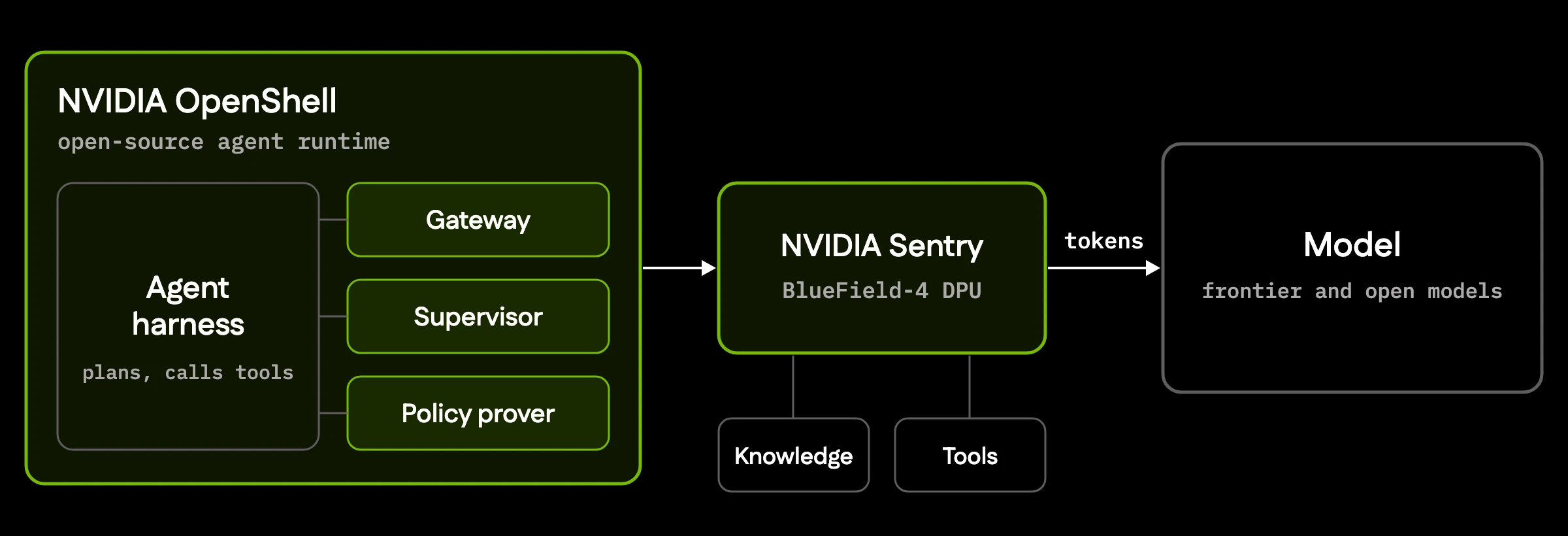
The result is a practical, reproducible workflow for the Open Agent Safety Platform (OASP), with NVIDIA OpenShell at its center. OpenShell is the open-source agent runtime: it governs what the agent may do, and everything else in the design attaches to it. The NVIDIA Agent Toolkit controls where the agent’s model calls may go, Protopia AI’s Stained Glass Transform ensures the model only ever sees protected representations, and NVIDIA Confidential Computing with attestation seals the machine it all runs on and proves it.
Where sensitive data leaks in an agentic pipeline
Take the example of a passport through an ungoverned agent, and count the hops. The agent reads it and keeps it in memory, in files, in the tools it calls. Its telemetry writes it to traces and logs. A router forwards it. The inference endpoint holds it in request logs, in caches, in CPU memory, and in GPU memory. NVIDIA Nemotron 3 Nano Omni is an open multimodal model with highest efficiency that powers sub-agents to complete tasks faster across vision, audio, and language. All of this runs on infrastructure the enterprise does not operate, and at every single hop the passport number sits in plaintext.
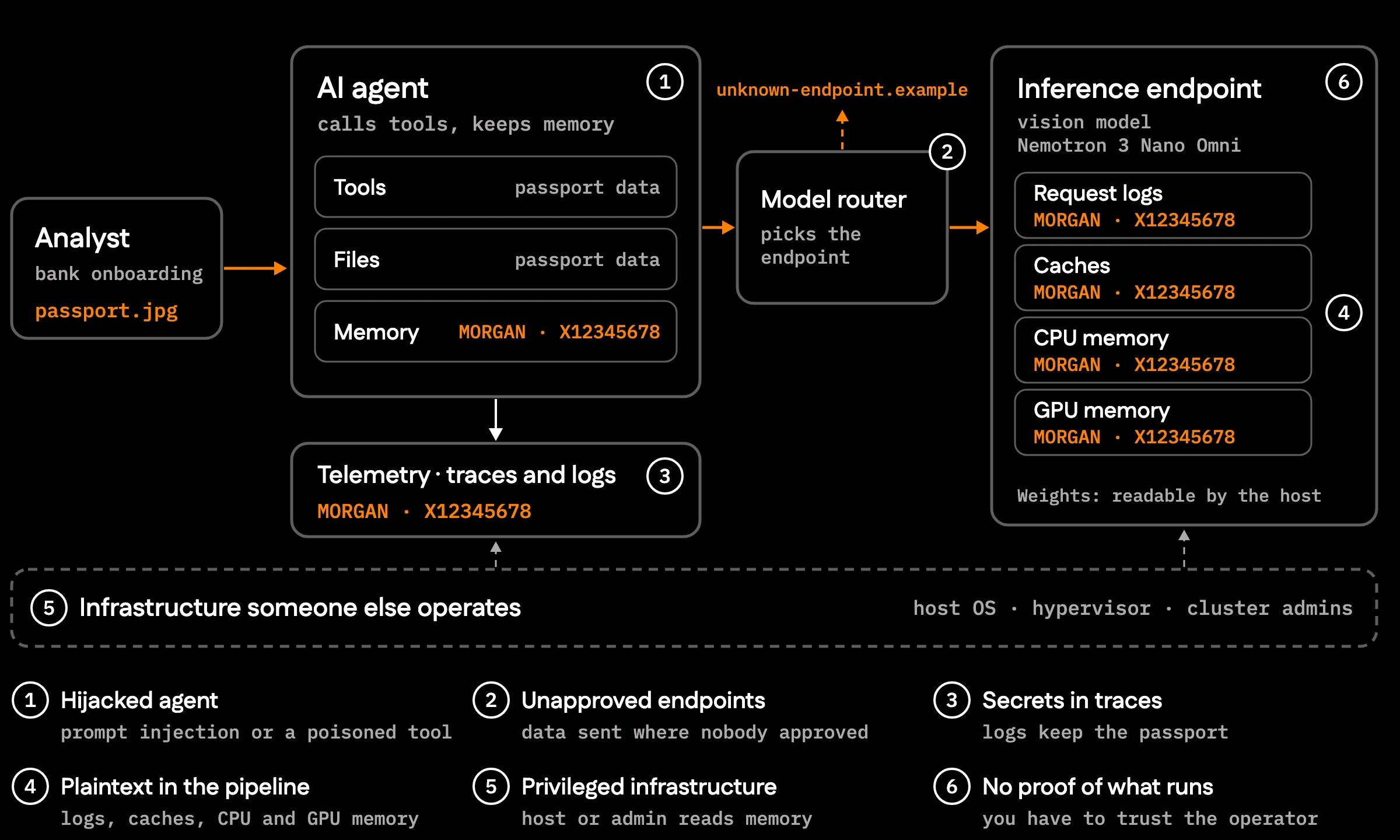
Plaintext at every hop is what turns the six risks in an agentic pipeline into six exposures:
- a hijacked agent acting on a prompt injection or a poisoned tool
- model calls sent to endpoints nobody approved
- secrets kept in traces
- plaintext across the serving pipeline
- agent and model memory open to the host layer
- no way to prove what is actually running
Any one of them exposes the passport in the clear. Encryption at rest and in transit are not sufficient, because the model has to work on the decrypted data in the clear.
Security teams know this list. What they have lacked is a stack where each exposure has its own independent control, and a way to see the whole stack working on a real request.
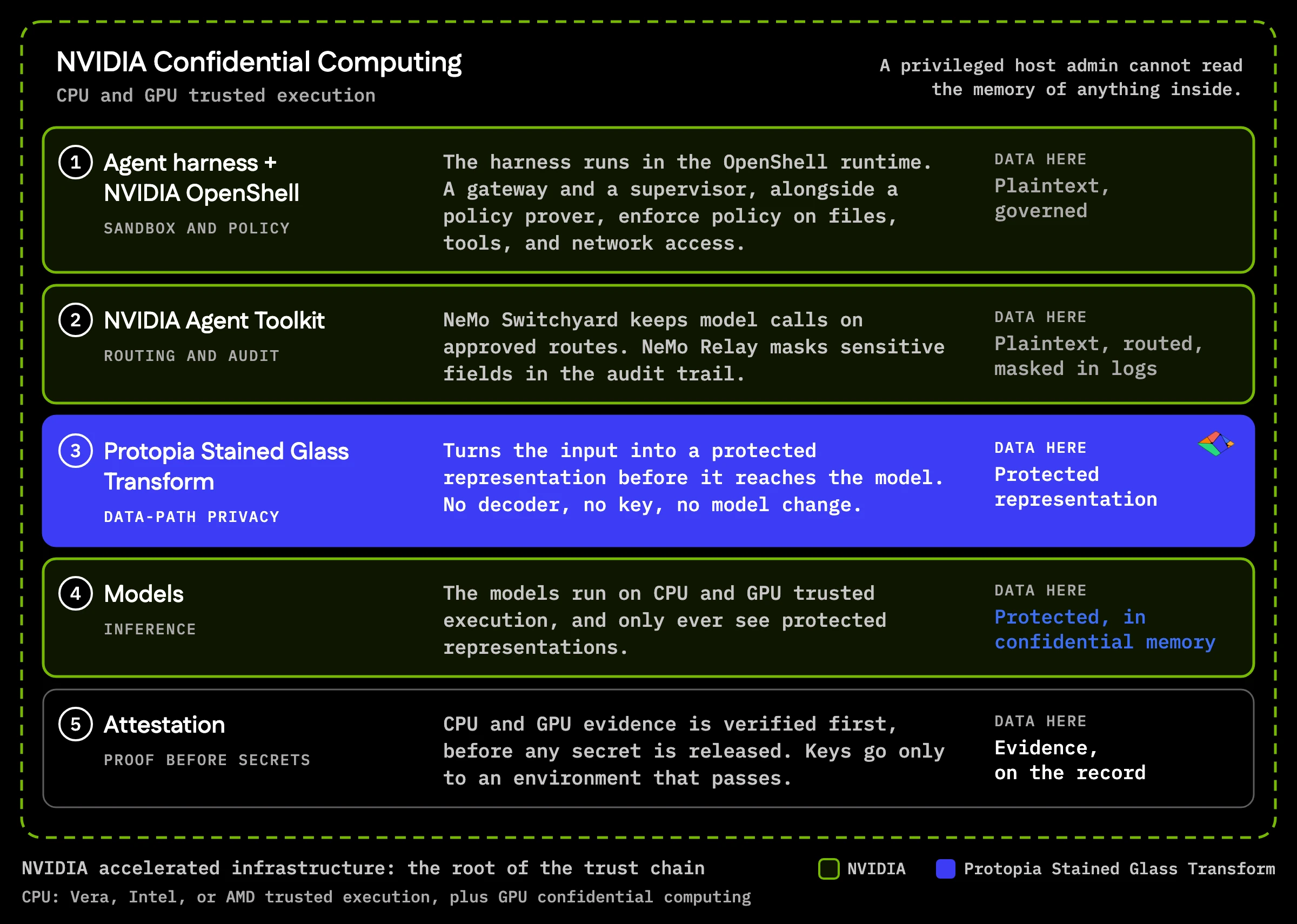
Six security layers for AI agents: True Defense in Depth
The reference design answers each exposure with its own layer, and the layers do not depend on one another, and each one completes and deepens the defense. It starts with the agent.
- NVIDIA OpenShell is the sandbox: the agent harness runs in the OpenShell runtime alongside a gateway, a supervisor, and a policy prover. Policy decides which files the agent can touch, which tools it can run, and which destinations it can reach. Anything unapproved is denied, and every decision is recorded, so a hijacked or prompt-injected agent can only do what policy allows.
- NVIDIA NeMo Switchyard keeps model calls on approved routes.
- NeMo Relay keeps the audit trail while masking sensitive fields.
- Stained Glass Transform protects the data path, so all downstream surface (whether data is at rest, in transit or in compute on those surfaces) do not expose plaintext.
- NVIDIA Confidential Computing protects the agent, its data, and the model weights in CPU and GPU memory while they run.
- Attestation verifies the hardware before any secret is released.
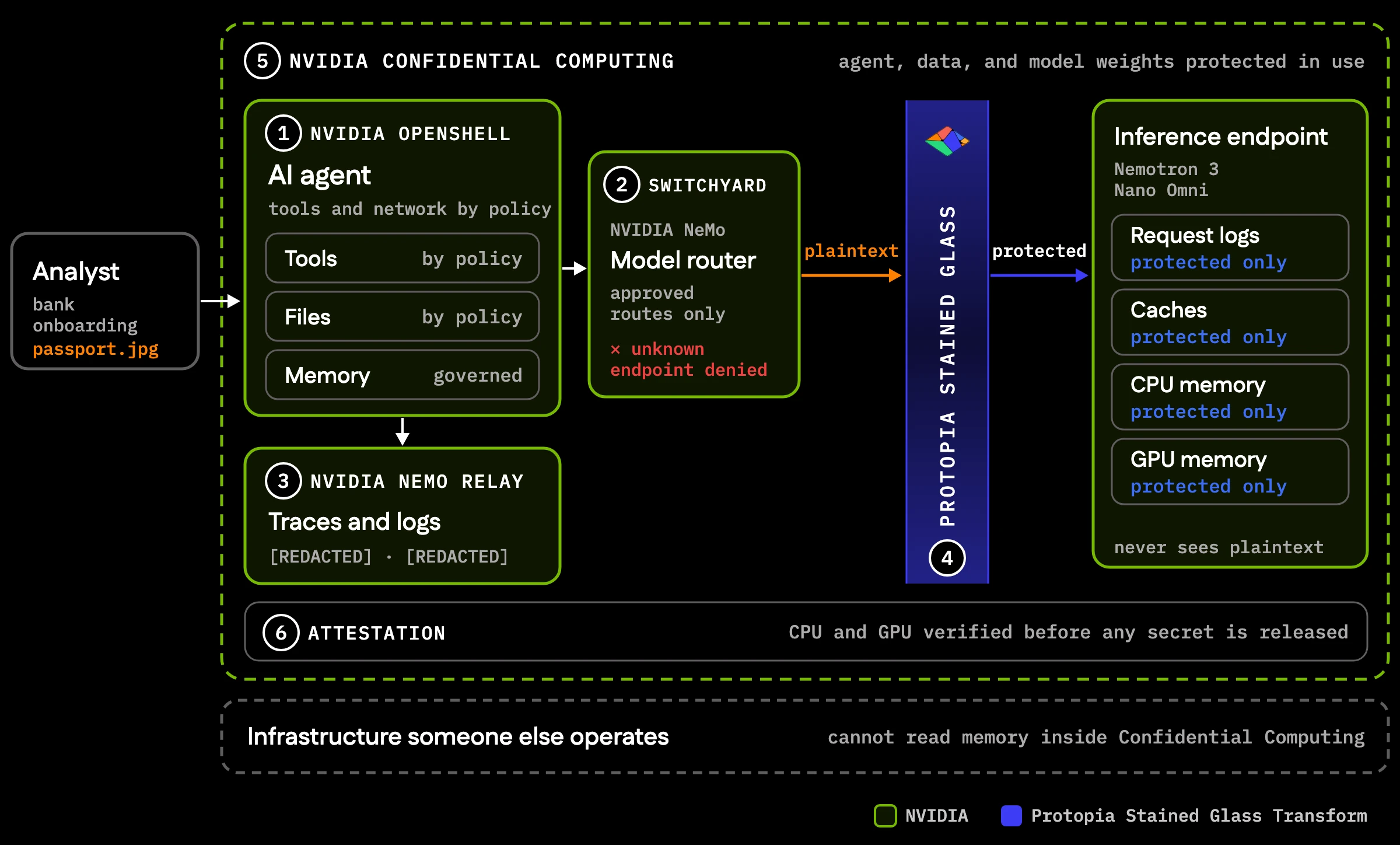
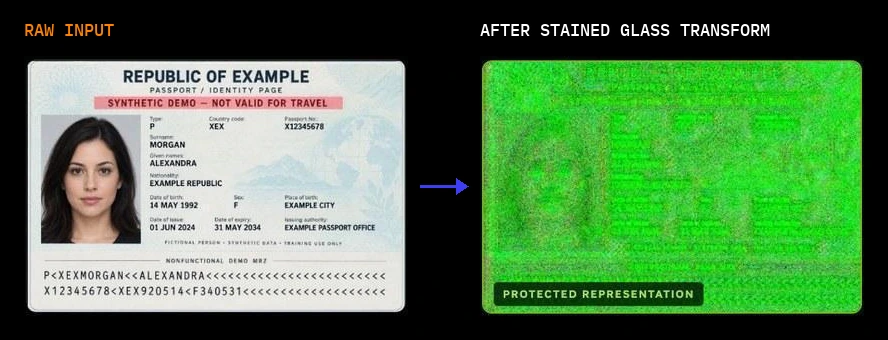
Protopia AI Stained Glass is where data protection lives. The Stained Glass Proxy turns each input into a stochastic protected representation upstream of the inference pipeline. Logs, caches, traces, and memory downstream never hold plaintext, there is no decoder and no key, and the model is unchanged: it works directly on the protected representation. That eliminates plaintext exposure across the serving pipeline as an architectural property, not a runtime policy. This single Stained Glass Transform covers multi-modal data – documents, images, and video frames – so the passport and the factory camera are both protected the same way.
Confidential Computing and Stained Glass Transform are complementary. Confidential Computing protects the model and its execution inside an attested boundary. Stained Glass Transform protects the data upstream of all of the inference pipeline’s operational surfaces. With both in place, the data never appears in plaintext, even inside the attested boundary. That joint configuration is the zero-trust AI factory.
Same Answer, different risk
The clearest way to see what the layers do is to run the same request twice, once with none of them and once with all of them. Both deployments get the same prompt: get the details of the person from the ID. Both return the same passport details. What differs is what happened to the passport on the way: where it was copied, who could read it, which routes the call was allowed to take, and whether anything verified the hardware it ran on.
With Security OFF, the agent calls NVIDIA Nemotron 3 Nano Omni directly, with nothing in between, and the passport is plaintext at every hop: agent memory, traces, the route, and the endpoint’s logs, caches, and memory. With Security ON, the agent harness runs inside NVIDIA OpenShell, where a gateway and a supervisor enforce policy. NeMo Switchyard keeps the call on an approved route and NeMo Relay masks personal data from the harness logs. The Stained Glass Proxy transforms the passport before it reaches the model, so the endpoint only ever receives a protected representation. All of it, model included, runs in Confidential Computing on the CPU and the GPU, on an NVIDIA RTX PRO 6000 Server.
The evidence is on screen, not asserted. OpenShell’s live audit shows the policy at work: in the recorded window, 113 requests allowed and 187 denied, with the approved model route allowed and an unapproved external endpoint denied. The audit records destination hostnames only, never requesting contents. The recorded CPU and GPU attestation appraisal shows exactly what was verified and when. Security OFF leaves the agent non-governed, personal data exposed in logs, routing uncontrolled, and the hardware unverified. Security ON leaves the agent governed, personal data redacted from the harness logs, routes approved, the hardware attested, and a model that never saw the passport in plaintext.
Why it matters
- Enterprises can put agents to work on regulated data, IDs, medical records, and financial records, and get useful answers without leaving plaintext in traces or serving pipelines, with proof from the hardware rather than promises.
- AI factory and sovereign cloud operators can run sensitive agentic workflows on cost-efficient, multi-tenant capacity, because the endpoint only ever receives protected representations. The dedicated carveouts that pin utilization low are no longer required. In deployments, GPU utilization moves from roughly 25% on single-tenant carveouts toward over 80% on multi-tenant operation.
- Security teams get one control per exposure: OpenShell policy over what the agent does, written and audited by the team rather than trusted to the agent, and a data-path property they can confirm by inspecting the serving layer rather than trusting every downstream component.
Everything in the reference design is available today. NVIDIA OpenShell is open source, and the design runs it as released. Stained Glass Transform is available for the NVIDIA Nemotron 3 family, including Nemotron 3 Nano Omni, with no changes to the models. NVIDIA Confidential Computing runs on current NVIDIA accelerated infrastructure. The same stack is the template for the OASP reference architectures now in progress with partners.
Govern the agent with NVIDIA OpenShell. Protect the data path with Stained Glass Transform. Seal the machine with NVIDIA Confidential Computing. Verify it all with attestation.
See it live at NVIDIA GTC DC, November 30 to December 3. The full Security OFF versus Security ON run will be on the floor; come find the Protopia AI team. Can’t make the show? Contact Protopia AI for a demo and we will run it for you.